
When people hear that Morion only distributes European automation brands, the first reaction is sometimes a raised eyebrow. There is an implication in the question that follows — are you being elitist? Are you dismissing capable manufacturers from other parts of the world simply because of geography?
It is a fair challenge. And it deserves a straight answer.
KNX Was Born in Europe, and Europe Never Stopped Pushing It Forward
KNX was established in 1990 as a unified European standard for building automation — the result of three competing European protocols merging into one open standard under the European Installation Bus Association. For the past 35 years, the most demanding real-world laboratories for KNX engineering have been European buildings — German commercial complexes, Belgian luxury residences, Dutch smart offices, Swiss hotels.
The manufacturers who have been building KNX hardware inside that environment for decades have been tested in ways that manufacturers from markets where KNX is newer simply have not. They have built to German engineering tolerances. They have been specified by European architects who will reject a product if it does not meet both a technical and an aesthetic standard simultaneously. They have shipped firmware updates that do not break existing installations. They have product lines with 20-year plus continuity.
This is not snobbery. It is a track record.
We work exclusively with European KNX brands — MDT Technologies from Germany, TENSE from Belgium, 1Home from Slovenia, Trivum from Germany, Fasttel from Belgium, — not because of where they are made, but because of what that origin represents in the specific context of KNX building automation. The two things are connected, and understanding why requires a brief look at where KNX came from and how the European market shaped it.
What European Engineering Actually Means in Practice
Take MDT Technologies, based in Ravensburg, Germany. MDT has been building KNX hardware since the protocol's early years. Their actuators, binary inputs, and logic modules are specified in hundreds of thousands of buildings across Europe. When an integrator opens an MDT panel, they know exactly what they are getting — not because MDT markets itself aggressively, but because the product has been in the field long enough to prove itself in every condition.
MDT's build quality reflects the environment it was designed for. German manufacturing tolerances. Components rated for 30-year operational life. Firmware that has been iterated over decades without breaking backward compatibility. An engineering team that treats a KNX panel not as a consumer product but as building infrastructure — the same category as electrical switchgear or HVAC plant.
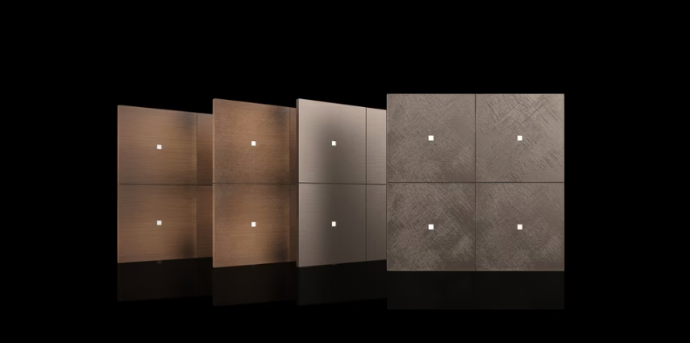
Or consider TENSE, the Belgian design keypad manufacturer. TENSE keypads are specified by interior designers and architects across Europe's most demanding luxury residential projects. They are not specified because they are the cheapest option or because they came with the right sales incentive. They are specified because they are the most considered object on the wall — glass faces with configurable backlight, flush-mounted with tolerance measured in fractions of a millimetre, available in finishes that a serious interior designer can work with. The design rigour behind a TENSE keypad reflects a European market where the aesthetic standard for a ₹20,000 per square foot house is genuinely uncompromising.
The Alternative and Why It Falls Short
There are KNX-compatible products manufactured in Asia — primarily China — that are significantly cheaper than their European counterparts. We are aware of them. We have evaluated them. We chose not to distribute them, and the reasons are specific.
The first is build quality consistency. European manufacturers operate under quality management systems that produce consistent output at scale. The tenth unit off the line performs identically to the first. In our evaluation of several Asian-manufactured KNX products, that consistency was not reliably present.
The second is firmware integrity. KNX projects are commissioned once and expected to run for decades. A firmware update that introduces instability in year three of a project is not a minor inconvenience — it is a serious problem for the integrator who staked their reputation on the system and the client who paid for it. European manufacturers have long update cycles, rigorous testing protocols, and a genuine commitment to backward compatibility. That discipline comes from decades of being held accountable by demanding European clients.
The third is support continuity. If MDT releases a product today, there is every reason to believe that MDT will still exist, still support that product, and still have spare components available in fifteen years. The same confidence does not attach equally to every manufacturer entering the KNX space from markets where the standard is newer and commercial incentives are more short-term.
What This Means for the Integrator
If you are a KNX integrator in India specifying a project for a client who is spending ₹80 lakhs on automation for their villa, you are making a long-term commitment on their behalf. The system you specify will be in that home long after the project is closed, the invoice is settled, and the client's next renovation begins.
The brand you specify is your reputation in that home for the next twenty years. When something works flawlessly a decade later, the client remembers who installed it. When something fails or becomes unsupported, the client also remembers who installed it.
European brands give you something that is genuinely difficult to price: the confidence that the product will still work, still be supported, and still look right in a decade's time. That confidence is worth the premium. And in the luxury segment, it is the only standard that makes sense.
Geography as Shorthand, Not Prejudice
To directly answer the question we started with — no, this is not snobbery. Geography is simply the most reliable shorthand for a set of qualities that matter enormously in professional building automation: engineering rigour, design integrity, long-term support commitment, and the kind of track record that only comes from decades of being held to the highest standard by the most demanding market in the world.
If a manufacturer from outside Europe meets all of those standards to the same level, we would work with them. We have simply not found one yet in the KNX space that does.
Until then, European is not a preference. It is a standard.
.
