
Walk into most homes that call themselves "smart luxury," and you'll find one wall that looks like a cockpit: forty switches, three remotes, a wall-mounted tablet nobody has opened since commissioning day. That wall isn't luxury. It's a to-do list wearing a glass finish.
The mistake is treating luxury as a function of control — as if giving a homeowner more ways to adjust more things is the same as giving them a better home. It isn't. Real luxury removes decisions. It doesn't multiply them.
What "Arrival" and "Goodnight" actually mean
Consider two scenes that should exist in any well-designed home. "Arrival" opens the gate, brings up the driveway and porch lighting, sets the climate to a pre-set comfort band, opens the curtains halfway, and starts a familiar playlist — triggered by one action, not five. "Goodnight" should never ask the family which of twelve zones to switch off room by room. That logic should already be designed, tested, and commissioned before the homeowner ever presses the button.
If either scene requires a decision tree, the automation hasn't done its job yet.
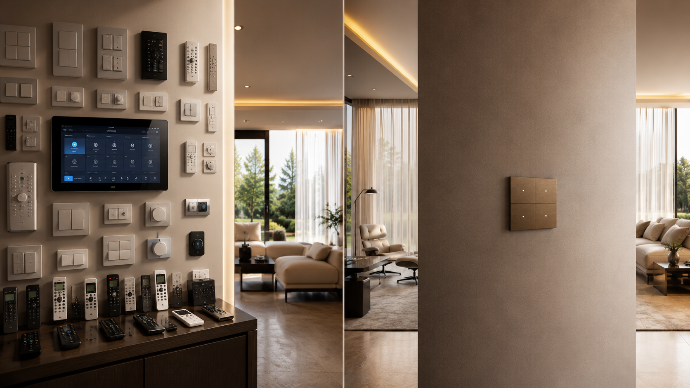
Invisible is the actual benchmark
The best KNX systems disappear into daily life. Nobody in the house thinks about the technology — lights simply respond, the climate simply settles, scenes simply happen. That disappearance is the real measure of quality automation. Not how many features a system has, but how rarely anyone has to think about using it.
This runs against the instinct of most integrators and vendors, who sell on feature count: more scenes, more zones, more app screens. Every one of those, unless it's collapsing a decision the homeowner used to make manually, is a smaller version of the cockpit wall.
A different design question
On the next project, don't only ask "what can we add?" Ask "what daily decision can we remove?" A homeowner who used to check three switches before leaving for work should now trigger one "Away" scene. A family that used to negotiate the thermostat every evening should have a climate profile that already knows the answer.
That reframing changes how a system gets scoped from day one — from "how many devices can we automate" to "how many decisions can we design out of this family's day," which is a harder, and far more valuable, question to answer well.
Where do you see automation in homes, offices, or hotels quietly adding decisions instead of removing them?
#knx #buildingautomation #luxuryliving #smarthomes
Start writing here...
