
Most of us do not think about electricity until the bill arrives.
The air conditioner runs a little longer than needed. Lights stay on in empty rooms. Phone chargers, TVs, speakers, Wi-Fi devices and kitchen appliances keep taking small amounts of power even when no one is using them. During the day, sunlight enters the home and heats it up, so the AC works harder later.
None of this feels like a big problem in the moment.
But over a month, these small things add up.
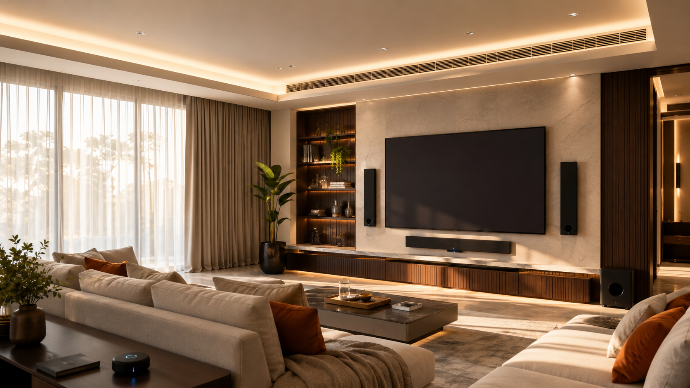
Today, homes in India are using more electricity than ever before. With more air conditioners, appliances, entertainment systems, smart devices and EV chargers entering modern homes, energy demand is only going to grow.
We believe the solution is not to use less technology.
The solution is to use smarter technology.
What Is Eco-Intelligent Living?
Eco-intelligent living simply means creating a home that understands when to use energy, when to save it, and when to switch to cleaner power like solar and use it efficiently.
It is not about living uncomfortably.
It is not about switching everything off manually.
It is not about compromising luxury.
It is about designing a home that quietly makes better energy decisions in the background.
For example, imagine this:
You leave your bedroom in the morning. The lights turn off automatically. The AC reduces cooling because the room is empty. The curtains adjust to reduce heat from direct sunlight. Devices that are not needed go into a low-power mode. If solar power is available during the day, the home uses it first before depending on the grid.
You do not have to remember anything.
The home simply works smarter.
The Everyday Energy Waste We Do Not Notice
Most energy waste inside a home is not dramatic. It is silent.
It comes from simple things like:
Lights and fans running in empty rooms.
AC cooling spaces that no one is using.
Chargers and electronics consuming power in standby mode.
Curtains staying open during peak heat, making rooms warmer.
Appliances running at the wrong time of day.
Solar power not being used in the most efficient way.
This hidden waste is why two homes with the same size and similar appliances can have very differentelectricity bills.
The difference is often not just what they own.
It is how intelligently the home is managed.
How Smart Automation Helps
A smart automation system connects the important parts of the home: lighting, air conditioning, curtains, security, sensors, appliances, solar power and battery storage.
Once these systems are connected, the home can make small energy-saving decisions throughout the day.
Here is what that looks like in real life.
1. Lights That Know When They Are Needed
Instead of relying only on switches, sensors can detect movement and daylight.
If enough natural light is available, the lights can dim automatically. If a room is empty, the lights can switch off. At night, the home can use softer lighting instead of full brightness everywhere.
This saves electricity and also makes the home feel more comfortable.
2. AC That Does Not Overwork
Air conditioning is often one of the biggest electricity users in a home.
Smart automation can reduce unnecessary cooling by adjusting the AC based on occupancy, time of day, temperature and sunlight.
For example, the system can cool only the rooms being used, reduce cooling when people leave, and work with curtains to keep heat out during the afternoon.
The result is comfort without waste.
3. Curtains That Help Control Heat
Curtains are not just for privacy. They also affect how hot a room becomes.
Motorised curtains or blinds can close during harsh sunlight and open when natural light is useful. This helps reduce heat gain and can lower the pressure on air conditioning.
It is a simple idea, but it can make a big difference in warm Indian cities.
4. Devices That Stop Wasting Standby Power
Many devices consume electricity even when they look “off”.
This is called phantom power or standby power.
TVs, chargers, speakers, gaming consoles, coffee machines, set-top boxes and other electronics may continue using small amounts of energy all day. Smart control can safely switch off selected non-essential devices when they are not needed.
You still get convenience.
You just reduce silent waste.
5. Solar Power That Is Used More Intelligently
Solar panels are powerful, but they become even more useful when the home knows how to use solar energy at the right time.
For example, the home can run selected appliances when solar generation is high, charge batteries during the day, and reduce grid use during peak hours.
This means every unit of solar power is used more wisely.
Example: A Smart 3BHK Home Layout With Energy-Saving Logic
Let us take a simple example of a modern 3BHK home.
Home Layout
Living Room
Smart lights
Motorised curtains
AC control
TV and entertainment standby control
Occupancy sensor
Master Bedroom
Smart lights
AC control
Curtain control
Bedside scene control
Charger and socket management
Bedroom 2
Smart lights
Fan and AC control
Occupancy sensor
Bedroom 3 / Study
Smart lights
Work desk plug control
AC or fan control
Daylight-based lighting
Kitchen
Appliance monitoring
Smart plugs for selected devices
Safety sensors
Balcony / Terrace
Rooftop solar connection
Battery storage
Energy monitoring
Central Automation Panel
Connects lighting, AC, curtains, appliances, solar and battery
Makes local decisions without depending on constant manual control
Example Monthly Energy Snapshot
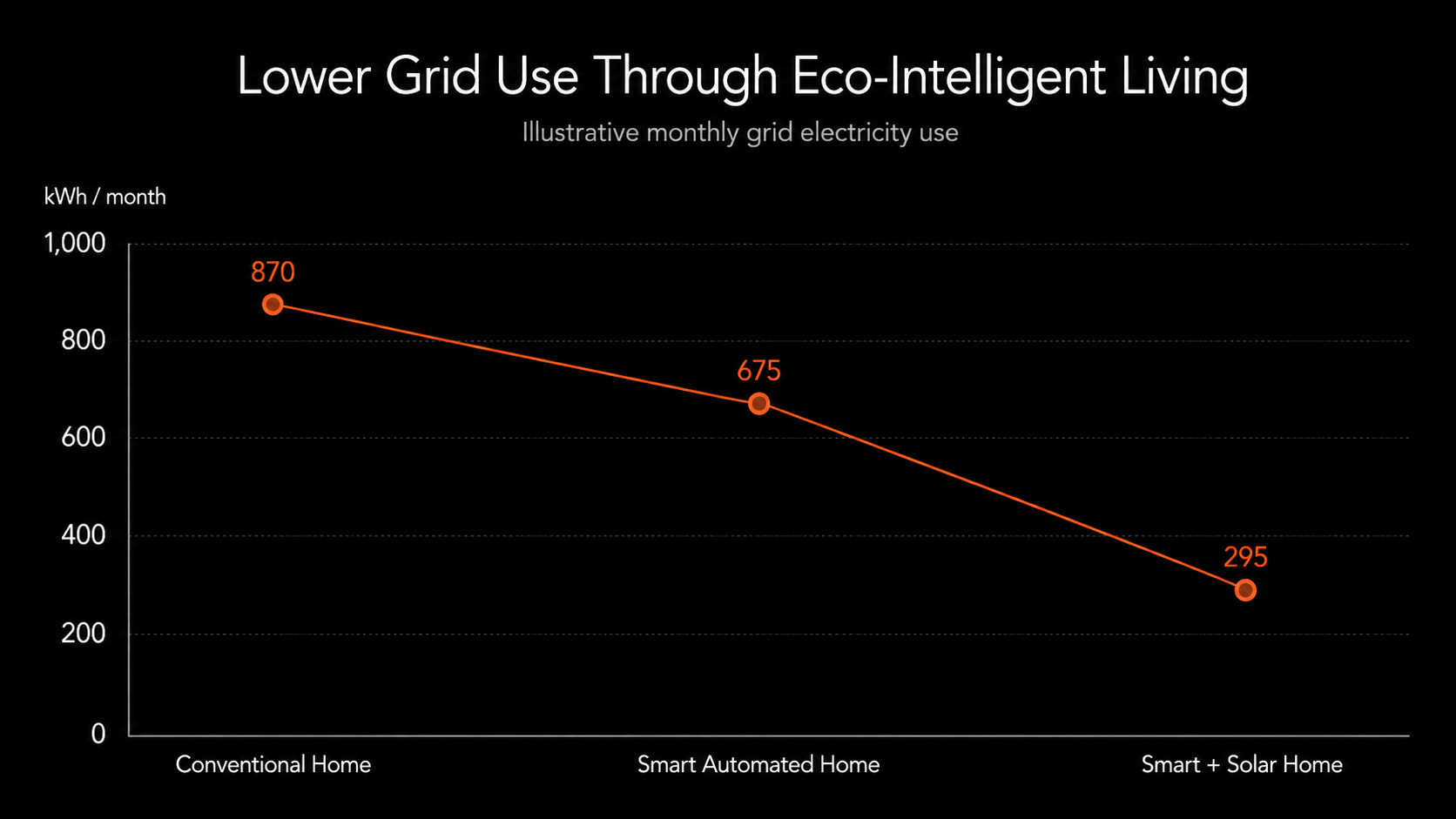
This is only an illustrative example. Actual savings depend on the home, lifestyle, appliance rating, weather, solar system size and usage habits.
Area of Energy Use | Without Smart Automation | With Smart Automation | What Changes |
Lighting | 120 units/month | 90 units/month | Lights dim or switch off when not needed |
Air conditioning | 450 units/month | 350 units/month | AC runs based on room use, heat and schedule |
Standby devices | 80 units/month | 45 units/month | Idle devices are switched off safely |
Appliances | 220 units/month | 190 units/month | Some usage shifts to better times |
Total grid usebefore solar | 870 units/month | 675 units/month | Around 195 units saved through smarter control |
Now add rooftop solar.
Solar and Battery Impact | Estimated Monthly Value |
Solar generation | 400 units/month |
Direct solar use by home | 280 units/month |
Battery-supported evening use | 100 units/month |
Remaining grid use | Around 295 units/month |
In this example, the home does not become efficient because one device saves everything.
It becomes efficient because many small decisions happen automatically every day.
Lights switch off when not needed.
Cooling becomes more intelligent.
Curtains reduce heat.
Standby power is reduced.
Solar is used at the right time.
That is the power of whole-home automation.
What Does “Net-Zero Ready” Mean?
A net-zero-ready home is a home designed to move closer to using as much clean energy as possible while wasting as little as possible.
It may not become fully net-zero on day one.
In simple words, it is a home that is ready for a cleaner and more efficient future.
Why This Matters for Modern Indian Homes
Indian homes are becoming more premium, more connected and more energy-dependent.
A luxury home today may include multiple air conditioners, automated curtains, home theatres, security systems, smart lighting, EV charging, water systems, appliances and always-on internet-connected devices.
Without intelligent control, all of this can increase electricity use.
With the right automation, the same home can become more efficient, more comfortable and more future-ready.
That is the difference between a connected home and an intelligent home.
Final Thought
The home of the future will not ask you to constantly think about saving energy.
It will help you save energy naturally.
It will know when to cool, when to dim, when to rest, when to use solar and when to reduce waste.
That is eco-intelligent living.
A home that cares for your comfort.
A home that respects energy.
A home that is ready for tomorrow.
References & further reading
CLASP — Residential Appliance Energy Consumption Survey India — https://www.clasp.ngo/research/all/residential-appliance-energy-consumption-survey-india/
Bureau of Energy Efficiency / NEEM Dashboard — National Energy End-use Monitoring — https://neemdashboard.in/introduction.php
International Energy Agency — Efficient cooling and rising electricity demand in India — https://www.iea.org/reports/energy-efficiency-2023/can-efficient-cooling-help-manage-fast-rising-electricity-demand-in-india-and-achieve-thermal-comfort-for-all
International Energy Agency — India’s electricity demand grows at night — https://www.iea.org/commentaries/india-s-electricity-demand-grows-at-night-managing-rising-cooling-demand
U.S. Department of Energy — Reducing standby power loads — https://www.energy.gov/energysaver/articles/3-easy-tips-reduce-your-standby-power-loads
Lawrence Berkeley National Laboratory — Standby Power Research — https://standby.lbl.gov/
KNX Association — Smart home and building automation standard — https://www.knx.org/
Have questions about net-zero-ready homes, smart automation or energy-efficient living? Drop a comment below or contact us at kausthub@morion.in — we’re happy to help.
